

LingQ Alternative
LingQ's method, without the learning curve
LingQ pioneered learning through reading, and its library built by thousands of contributors over fifteen years is genuinely hard to match. What sends people looking elsewhere isn't the idea, it's the interface: word statuses, filters, multiple views, a setup phase before the first real reading session. Lira keeps the core loop, translate as you read, review what sticks, and cuts everything standing between you and the text.
Start reading freeQuick verdict
- ✓LingQ: massive library, rare languages included
- ✗LingQ: interface needs real ramp-up time
- ✓Lira: open a text and read, no setup
Quick verdict
- ✓LingQ: massive library, rare languages included
- ✗LingQ: interface needs real ramp-up time
- ✓Lira: open a text and read, no setup
Self-check
Is LingQ's status system actually slowing you down?
4 questions to find out if you're reading, or doing data entry.
Question 1 of 4
After a reading session, how much time do you spend marking each word's status (1, 2, 3, known...)?
LingQ or Lira: what to keep from each?
LingQ remains the strongest choice for rare languages and for learners who want a huge ready-made library with granular statistics. Lira isn't trying to out-catalogue it. In commonly taught languages, it gives you a simpler start: a text you already have or a guided reading, with as little interface as possible between you and the page.
| LingQ | Lira | |
|---|---|---|
| Spaced repetition engine (FSRS) | ✓ | ✓ |
| Import your own EPUB / PDF / article instantly | ~ | ✓ |
| Single tap to translate, no view switching | ✗ | ✓ |
| No manual word-status system to maintain | ✗ | ✓ |
| Rare language coverage (Turkish, Czech...) | ✓ | ✗ |
| Massive community-built content library | ✓ | ✗ |
| Free to use | ~ | ✓ |
No dashboard to configure: open a text and start reading, translating as you go.
LingQ's word-status system (new, recognized, known) gives a precise sense of progress, and its library covers over 30 languages, including rare ones most tools ignore. That depth comes with real interface weight: before you can just read, there's a system of colors, filters, and counters to learn. Forum threads on r/languagelearning return to the same point again and again: new users want to open a text and start, not configure a workflow first. Lira answers the same underlying need, reading real content to learn, by starting from the text itself rather than from a dashboard.
Start with your text or a guided reading
Bring an EPUB, a PDF, or an article you already want to read. Or start with a guided reading built around a real-life situation, then understand and reuse what you meet there.
Choose a start
Open your own EPUB, PDF, or article, or select a guided reading. No setup screen.
Reading
Tap a word for its contextual translation, right inside the page, no separate view to switch to.
Review
Words you look up move into FSRS spaced repetition automatically, no manual status to set.
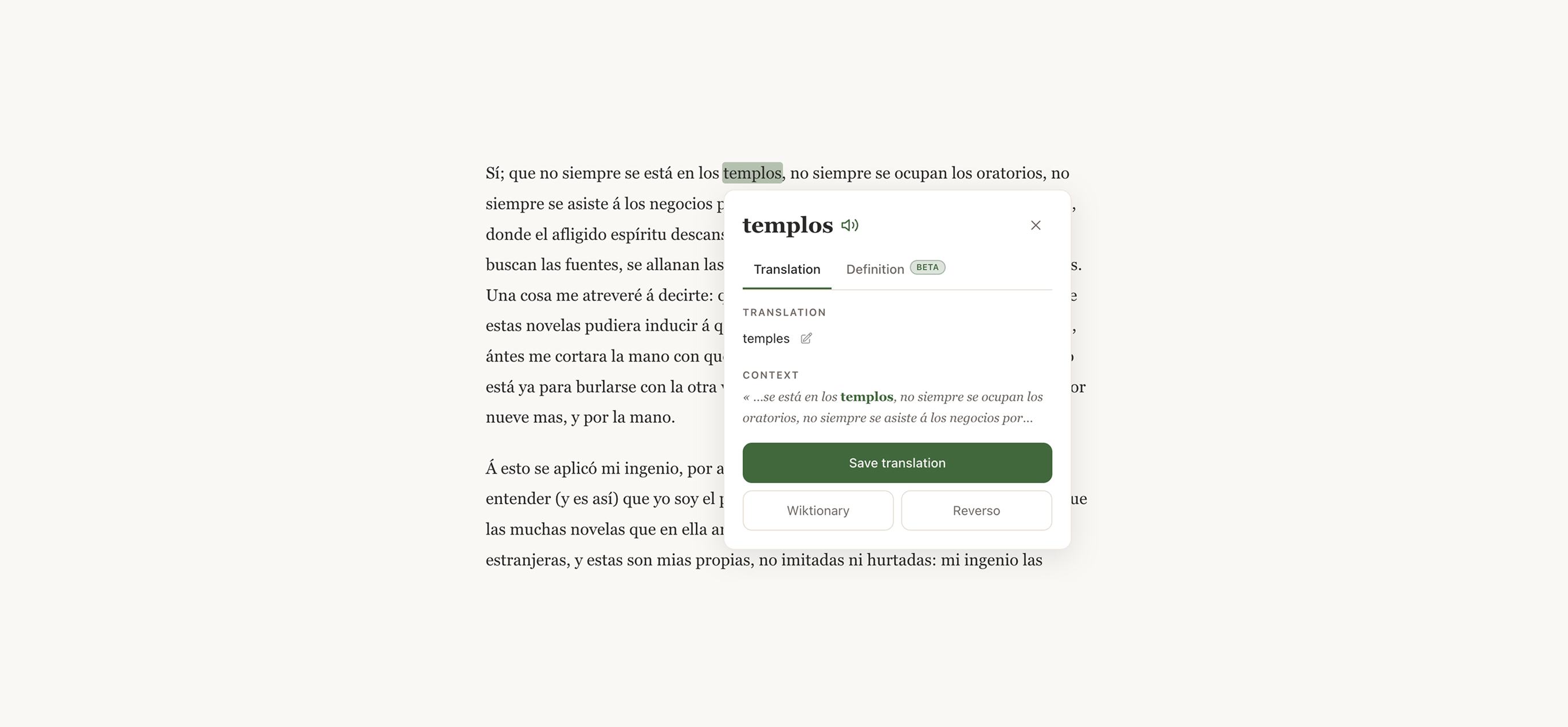
La vida sigue igual después de la tormenta.
What Lira actually does
Your own text or a guided reading
Drop an EPUB, a PDF, or paste an article URL; or begin with a guided reading built around a real-life situation. Both lead into the same reading and review loop.
One tap, no word statuses to manage
Click a word for its translation and context, right where you're reading. No new/recognized/known system to maintain by hand as you go.
FSRS running quietly underneath
Every word you look up more than once enters spaced repetition automatically. You keep the tracking benefit LingQ built its reputation on, without the manual bookkeeping.
What you actually see while reading
No dashboard to configure first: here are the screens you use day to day, from opening a text to reviewing what you saved.
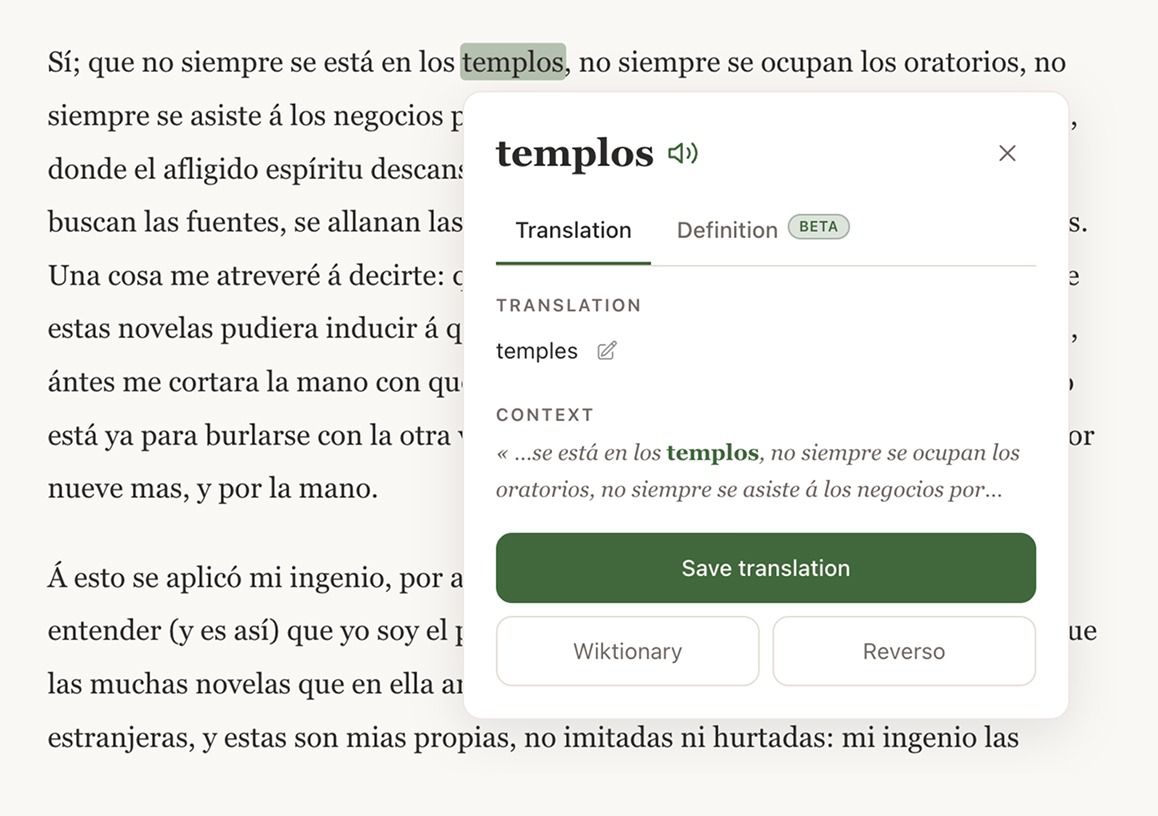
Tap a word, keep reading
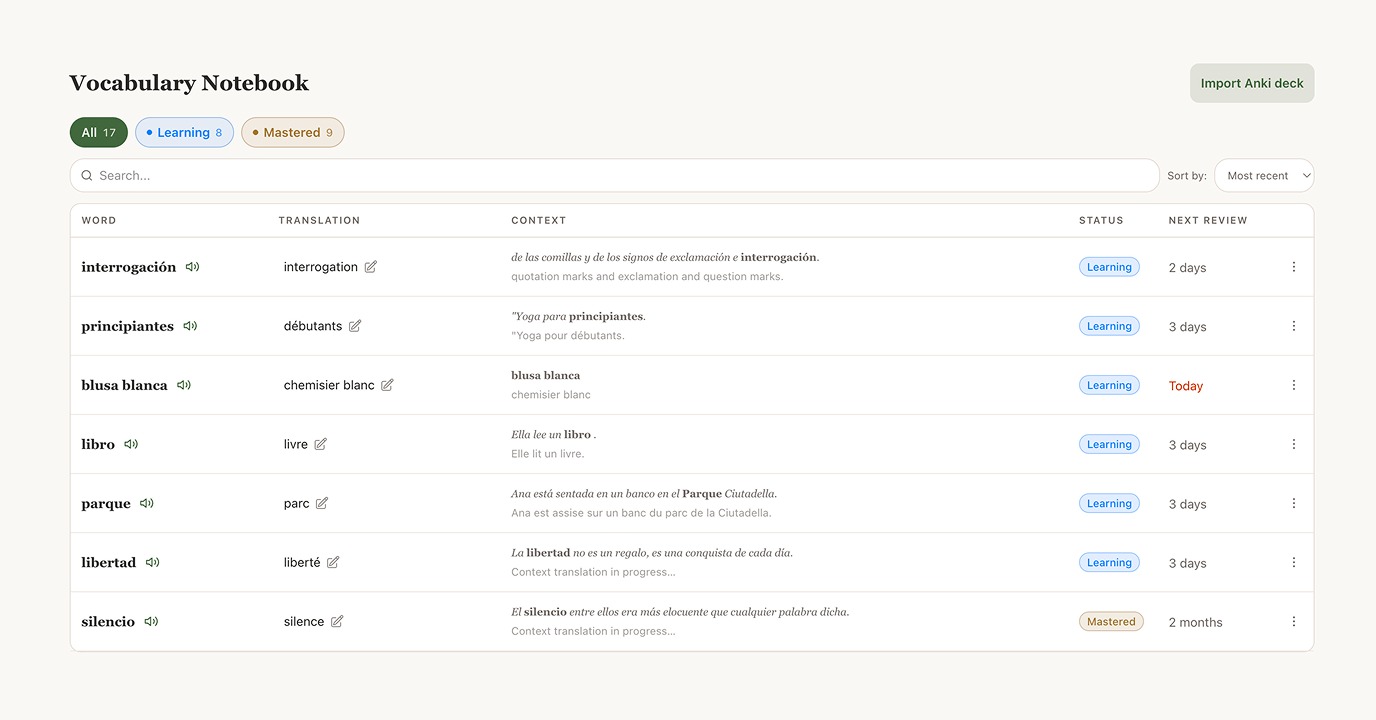
Every saved word keeps its original sentence
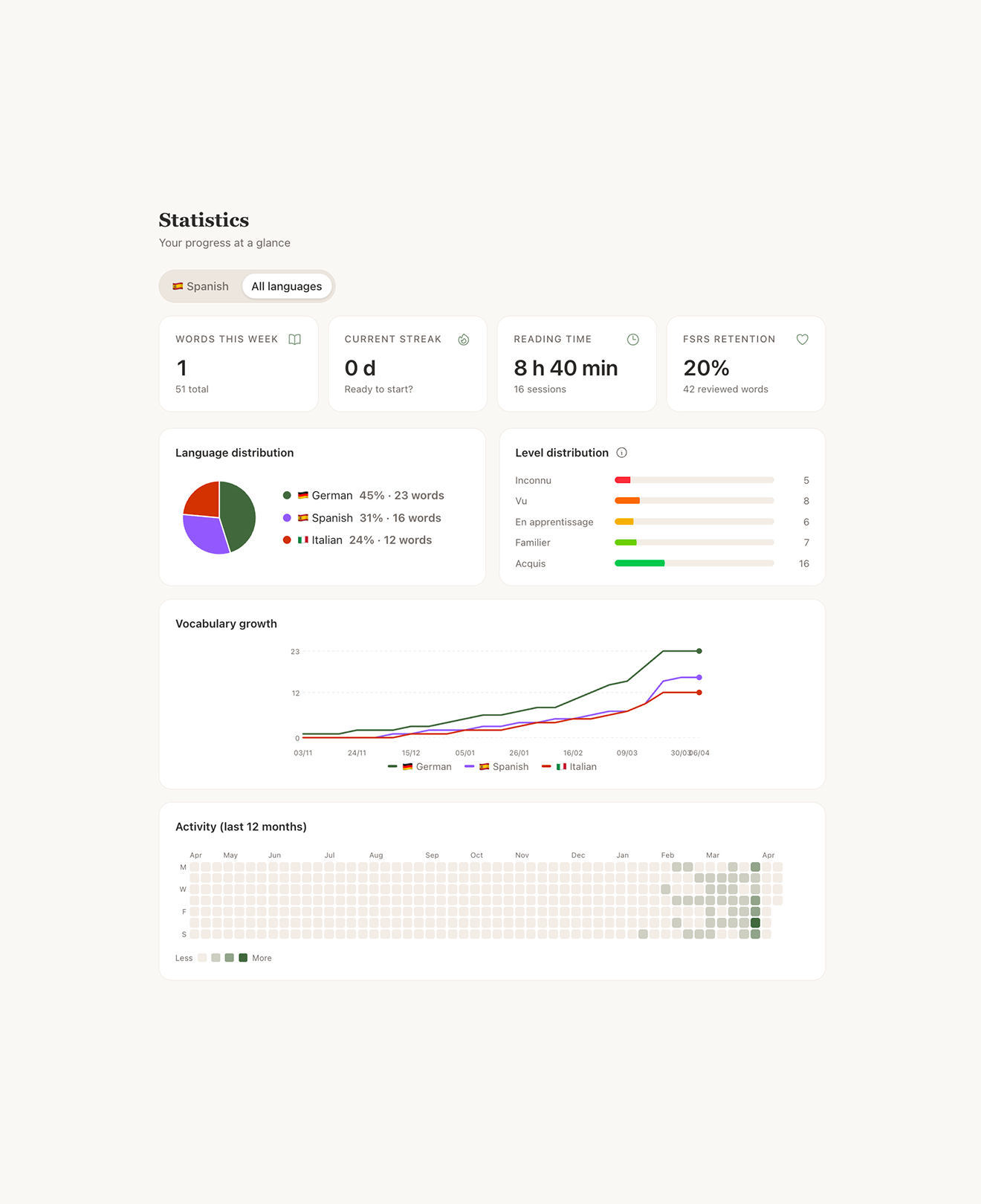
Progress tracked without a manual status system
The science
Same principle, less friction to benefit from it
Both tools rely on the same finding from second-language acquisition research: vocabulary retained in context sticks far better than vocabulary memorized in isolation. LingQ built a full tracking system around that idea; Lira applies the same principle but automates the bookkeeping with FSRS (Free Spaced Repetition Scheduler), the open-source algorithm also used by Anki. Without spaced review, retention drops fast (the gray curve). With reviews timed right before you'd forget, it climbs and stabilizes (the green curve). The difference here is how much setup stands between you and that curve.
Vocabulary retention over time
One more thing worth knowing before you subscribe
LingQ's terms of service state that plans are billed in advance monthly and are non-refundable, with no refunds or credits for partial months. Lira's free plan doesn't ask for a card, so there's nothing to cancel or get refunded while you figure out if it fits your reading habits.
LingQ's known-word counter also treats each conjugated form as a separate word: "do", "does", "doing", and "did" each add to your total individually, a pattern other language-app builders have called out publicly as inflating the headline number. Lira's vocabulary notebook groups conjugated forms under their root word instead, while still tracking each form's own spaced-repetition schedule separately, since recognizing "do" doesn't mean you'll recognize "doing" mid-sentence.
I kept losing ten minutes to LingQ's interface before I even started reading. Here I open a PDF and I'm already going.
Marc, 34
LingQ's library is great for Turkish, but for Spanish I just wanted to read my own novel. Lira does exactly that.
Sofia, 27
No more word statuses to update by hand. I read, I tap, it's tracked.
Yohan, 22
Go further
Best Books to Learn French at A2/B1 Level
Explore 8 French books suited to A2/B1 learners, from free public-domain classics to modern favorites, to build reading skills with Lira.
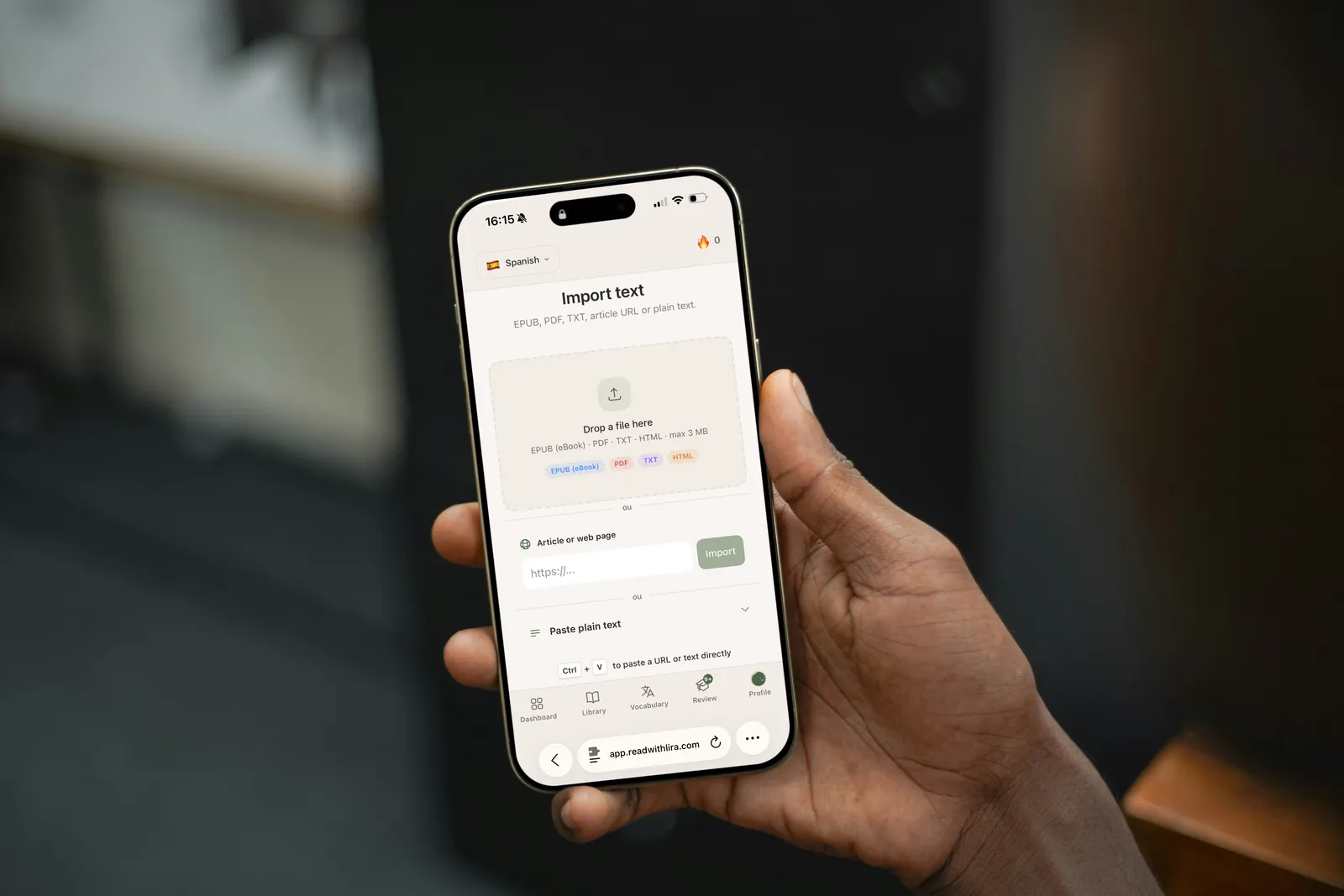
How to Import a Book or Article Into Lira
A step-by-step guide to importing an EPUB, PDF, URL, or plain text into Lira, and how to start reading the right way.

Extensive Reading: The Complete Guide to Learning a Language
Extensive reading means picking texts you already understand at 90-95%. Here's why it works, how to start with Lira, and how to avoid common mistakes.

Skip the setup, keep the method
Drop in a text you actually want to read, for free, and start translating in under a minute.
Start reading free