

Comparison
Anki alternative: review vocab without building flashcards
Why is Anki so hard to stick with for language learning?
Anki is a spaced repetition engine, not a language learning method. That distinction matters. The algorithm is excellent, but it does nothing until you've picked the words yourself, written the definitions, formatted the cards, and often installed add-ons just to get audio or images working.
That upfront work is called "card making," and it's the top reason learners quit Anki when they try to use it for a living language. You spend an hour building twenty clean cards, then you're too tired to actually review them the same day.
Shared decks solve part of the problem and create another. A generic "top 5000 Spanish words" deck contains words stripped of context, often without an example sentence, sometimes with rough community-made translations. You end up memorizing words you've never encountered anywhere, which makes retention harder: your brain holds onto what it has already met in a real context far better than a word floating on its own.
How does Lira build vocabulary differently?
Lira flips the order of operations. You don't pick a word list before reading. You read a text you already care about (a novel, an article, a book you imported as EPUB or PDF, or a classic from the Gutenberg library), and you tap an unfamiliar word to see its contextual translation.
That word gets added to your review queue automatically, along with the exact sentence where you found it. No generic definition to copy, no card to format, no add-on to hunt down for audio. The card already exists, with the real context attached.
Vocabulary learned this way has a concrete edge: it matches what you're actually reading. If you're reading detective novels in German, your deck fills up with crime-related vocabulary. If you're reading science articles in English, your deck reflects that exact field. A generic shared deck can't do that.
How much time does card creation actually take in Anki?
Run the numbers with realistic figures. A learner aiming for 20 new cards a day, a reasonable pace for steady progress, spends on average two to three minutes per card picking the word, looking up a reliable definition, writing an example sentence, and maybe adding audio or an image. That's 40 to 60 minutes of prep, before the review session itself even starts.
Over a week, that can add up to five or six hours spent purely on card prep. Plenty of learners keep up this pace for the first two weeks, carried by novelty, then quit once the prep workload outweighs the time actually spent engaging with the language.
Shared decks cut down on prep time, but at the cost of relevance. A generic frequency deck contains words you might never encounter in what you're actually reading or watching, which makes every review session feel more abstract and harder to anchor to real language use.
Anki vs Lira: when is each the better choice?
The honest comparison comes down to the type of content you want to learn, not a blanket claim that one tool beats the other.
| Criterion | Anki | Lira |
|---|---|---|
| Card creation | Manual (or generic shared deck) | Automatic from your reading |
| Structured academic content (medicine, law, Japanese kanji) | Very strong, specialized decks exist | Not built for this |
| Living-language vocabulary via reading | Possible but heavy to set up | Built for this natively |
| Algorithm customization | Highly tunable (advanced settings, add-ons) | Simple, no configuration needed |
| Shared deck community | Massive (AnkiWeb) | Nonexistent, every deck comes from your own reading |
| Multimedia support (audio, images) | Yes, via add-ons you install | Native text context, nothing to add manually |
| Cost | Free on desktop and Android, paid on iOS | Free with daily limits, paid tier available |
For structured, academic content, medical vocabulary, law, or Japanese kanji with their multiple readings, Anki still wins. Its community has built extremely thorough decks on these exact subjects, and its tuning engine lets you fine-tune review intervals for dense material like this.
For learning a living language through authentic reading, Lira removes Anki's core friction: creation. Vocabulary comes from what you're actually reading, not from a list someone else decided was relevant on your behalf.
Do Anki and Lira use the same spaced repetition method?
Both rely on a form of spaced repetition, but their histories differ. Anki defaults to the SM-2 algorithm, designed in the 1980s for SuperMemo. Since 2023, Anki has offered FSRS (Free Spaced Repetition Scheduler) as an option, a newer machine-learning-based algorithm, adjustable manually in the advanced settings (Anki's official FSRS documentation).
Lira uses FSRS natively, with no setup required. The algorithm automatically adjusts the interval between two reviews of a word based on your actual performance, without you needing to understand the technical parameters underneath.
This difference doesn't make one tool strictly better than the other for raw memorization: FSRS is FSRS, whether it runs inside Anki or inside Lira. A study on the effectiveness of spaced repetition confirms that the general principle (reviewing just before you'd forget) matters more than the exact algorithm implementation. What changes between the two tools is the friction upstream: whose job it is to build the cards in the first place.
Does vocabulary learned through reading cover everything you need?
No, and it's worth saying that plainly instead of overselling the method. Reading exposes you to whatever vocabulary naturally shows up in the texts you choose. If you only read contemporary fiction, you'll never encounter the administrative vocabulary needed to fill out an official form, or certain technical terms from a field you've never read about.
That's a real limitation, not a footnote. A learner preparing for a standardized language exam, with specific vocabulary lists to master, is better off supplementing their reading with targeted study of those lists, whether that's through Anki or another tool.
For most self-taught learners, whose goal is to read books, follow shows in the original language, or hold a conversation about topics they actually care about, this limitation matters less. The vocabulary missing from your reading is often vocabulary you don't immediately need. And as you vary what you read, novels, articles, essays, coverage widens on its own, without you having to plan it.
Do you have to choose between Anki and Lira?
Nothing stops you from using both for different purposes. A learner preparing a formal language exam with precise technical vocabulary can keep a dedicated Anki deck, while reading novels in Lira to build everyday vocabulary without any prep work.
The question worth asking is simple: would the time you'd spend building cards be better spent just reading? For most learners who want to improve by reading books, articles, or texts they genuinely care about, the answer leans toward reading. Vocabulary then builds itself, with no manual curation step standing between you and the language.
There's also a motivation angle worth naming. Card creation is a maintenance task, it doesn't feel like progress even when it technically supports it. Reading a chapter of a book you chose because you wanted to, on the other hand, feels like the actual goal you set out to reach. When the vocabulary review comes as a side effect of that reading rather than a separate chore, it's easier to keep the habit going past the first few weeks.
If you want to compare Lira to other language learning apps, our language app comparison breaks down the differences with Duolingo and LingQ.
FAQ
Can you import Anki decks into Lira?
No, Lira doesn't currently support importing Anki decks. The mechanics are different: vocabulary builds up as you read inside the app rather than coming from an imported list.
Is Anki free?
Anki is free on desktop (Windows, Mac, Linux) and on Android. The official iOS app is paid, a one-time purchase. Lira is free with daily limits, with a paid tier for unlimited use.
Is Anki still worth using if I already use Lira?
Yes, for structured technical or academic vocabulary (medicine, law, kanji) where the Anki community's shared decks are extremely thorough. For learning a living language through reading, Lira removes the upfront friction Anki requires.
How long does it take to see results from vocabulary built through reading?
It depends on how much you read, not a fixed number. A learner reading regularly, 15 to 20 minutes a day, encounters enough new words within a few weeks to build a solid review queue, without ever opening a card editor.
For any other question about how Lira works, check our FAQ or get in touch.
Lira
The Lira team builds a reading app that adapts to your real level and schedules your vocabulary reviews with the FSRS algorithm.
Start reading in your target language
Import a book, an article, or pick a free classic, and Lira translates unknown words as you go.
Start for freeRelated articles
 Tutorial
How FSRS spaced repetition works in Lira
FSRS calculates the optimal review interval for every word you learn. Here's exactly how that works in Lira, word by word.
 Tutorial
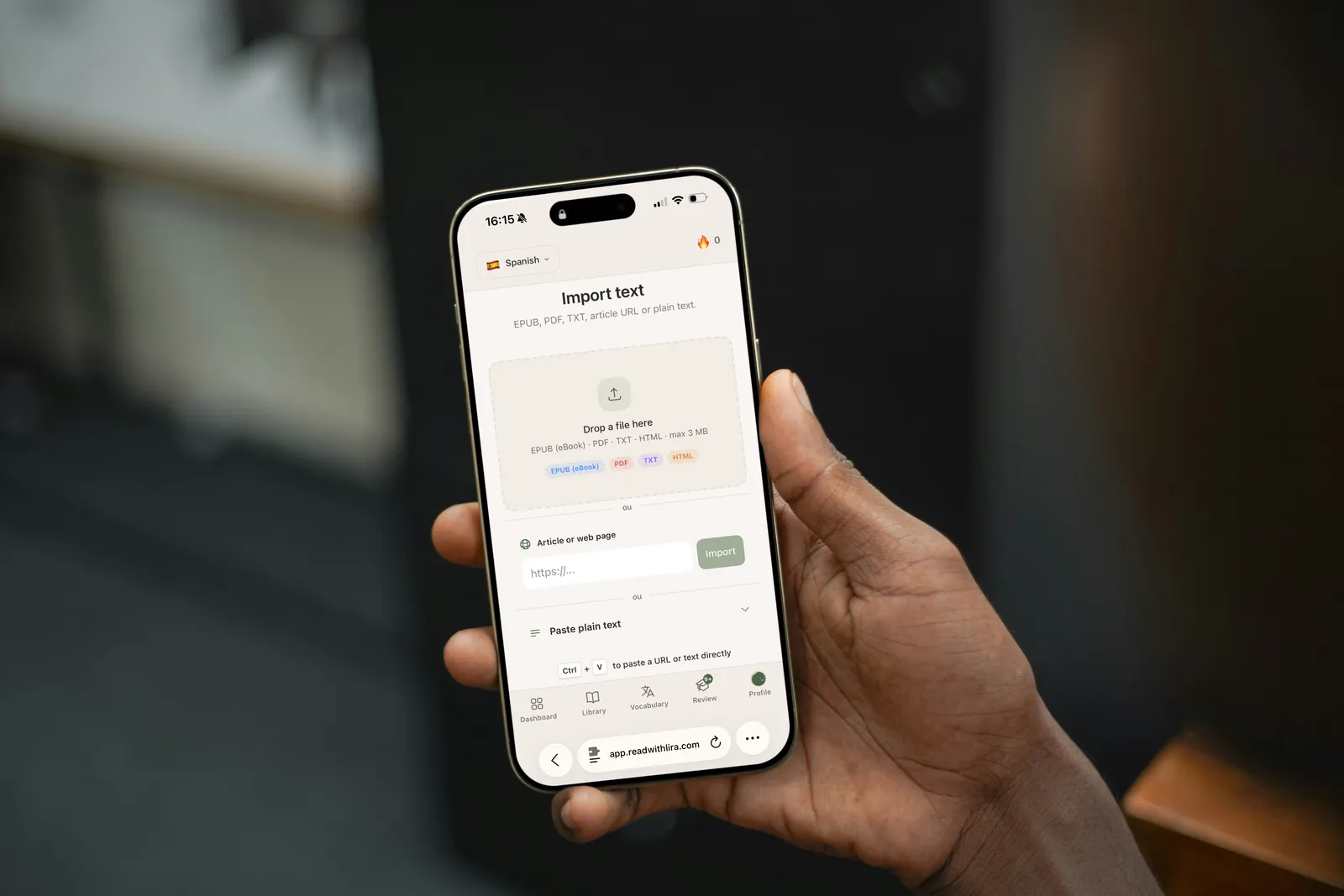
How to Import a Book or Article Into Lira
A step-by-step guide to importing an EPUB, PDF, URL, or plain text into Lira, and how to start reading the right way.
 Comparison
The Duolingo Plateau: Why You Stall (and How to Fix It)
Finished the Duolingo tree but still can't read a simple article? Here's why the plateau happens and how Lira helps you move past it.