

Comparison
Busuu alternative: learning a language with real texts instead of scripted lessons
What does Busuu do well?
Busuu offers courses structured by level of the Common European Framework of Reference for Languages (CEFR), from A1 to B2, with progressive vocabulary, grammar, and comprehension exercises (Busuu, teaching method). This step-by-step progression reassures complete beginners, who know exactly where they stand and what to learn next.
The app also relies on community correction. A native speaker reviews your written sentences or audio recordings and sends back real human feedback, a genuine strength against purely automated tools. An AI conversation chatbot rounds things out for practicing dialogue without waiting for a corrector to be available.
For a total beginner in German or Spanish, this guided framework avoids two classic traps: wandering without a method, or giving up for lack of feedback on mistakes. That's a real strength, one it would be dishonest to downplay.
Busuu has also invested in certification. The app offers CEFR-aligned level tests, useful for a résumé or an academic application. Few consumer apps bundle this kind of official benchmark directly into the product.
Which profile is Busuu the best fit for?
Busuu excels with A0 and A1 profiles, people starting a language from zero. At this stage, learners need to be told what to learn, in what order, and need their first sentences corrected before a bad habit sets in.
Busuu's scripted dialogues cover useful starter situations: ordering at a restaurant, introducing yourself, asking for directions. This survival vocabulary forms a solid base before going further.
A simplification to avoid: claiming Busuu is "useless" past a certain level. That's false for a beginner who still needs a guided path and regular human correction. The question isn't the quality of the tool, it's the fit between the format and the learner's level.
The AI conversation chatbot reinforces this advantage for beginners. It lets you practice forming simple sentences at any hour, without waiting for a native speaker to be available for correction. That immediate availability partly offsets the slower pace of community correction, which depends on other users volunteering their time.
What Busuu is missing for an intermediate learner
The scripted format shows its limits once the basics are in place. The dialogues stay short, predictable, written to illustrate a grammar rule rather than to reflect the language as it's actually written. A novel, a news article, or an essay doesn't follow that controlled structure.
The practical result: a learner who finishes Busuu's B1 level recognizes vocabulary in multiple-choice exercises but still struggles with a newspaper article, where sentences run longer, phrasing is less predictable, and vocabulary isn't filtered.
The CEFR itself anticipates this. Level B1 corresponds to an "independent" user able to grasp the main points of a standard text, not yet a reader comfortable with complex topics or literary language (Council of Europe, CEFR). Clearing that hurdle requires different training: exposure to long, authentic text, not more dialogues.
A second limit: Busuu offers little long-form content. Lessons stay short by design, built for a few-minute session. But reading comprehension is built through repeated exposure to whole texts, not isolated fragments.
This isn't a flaw in the design, it's a tradeoff. Short lessons keep the app easy to pick up daily, which matters enormously for habit formation. But that same brevity caps how far the format can take a learner once the goal shifts from "build a habit" to "understand a real text."
A third point worth naming: the vocabulary in scripted dialogues stays deliberately narrow. A restaurant scenario recycles the same twenty words. A real book chapter uses several hundred, many appearing only once. That uncontrolled variety is exactly what's missing to progress toward an advanced level, and no dialogue format can reproduce it without losing its structured nature.
How Lira takes over from A2/B1
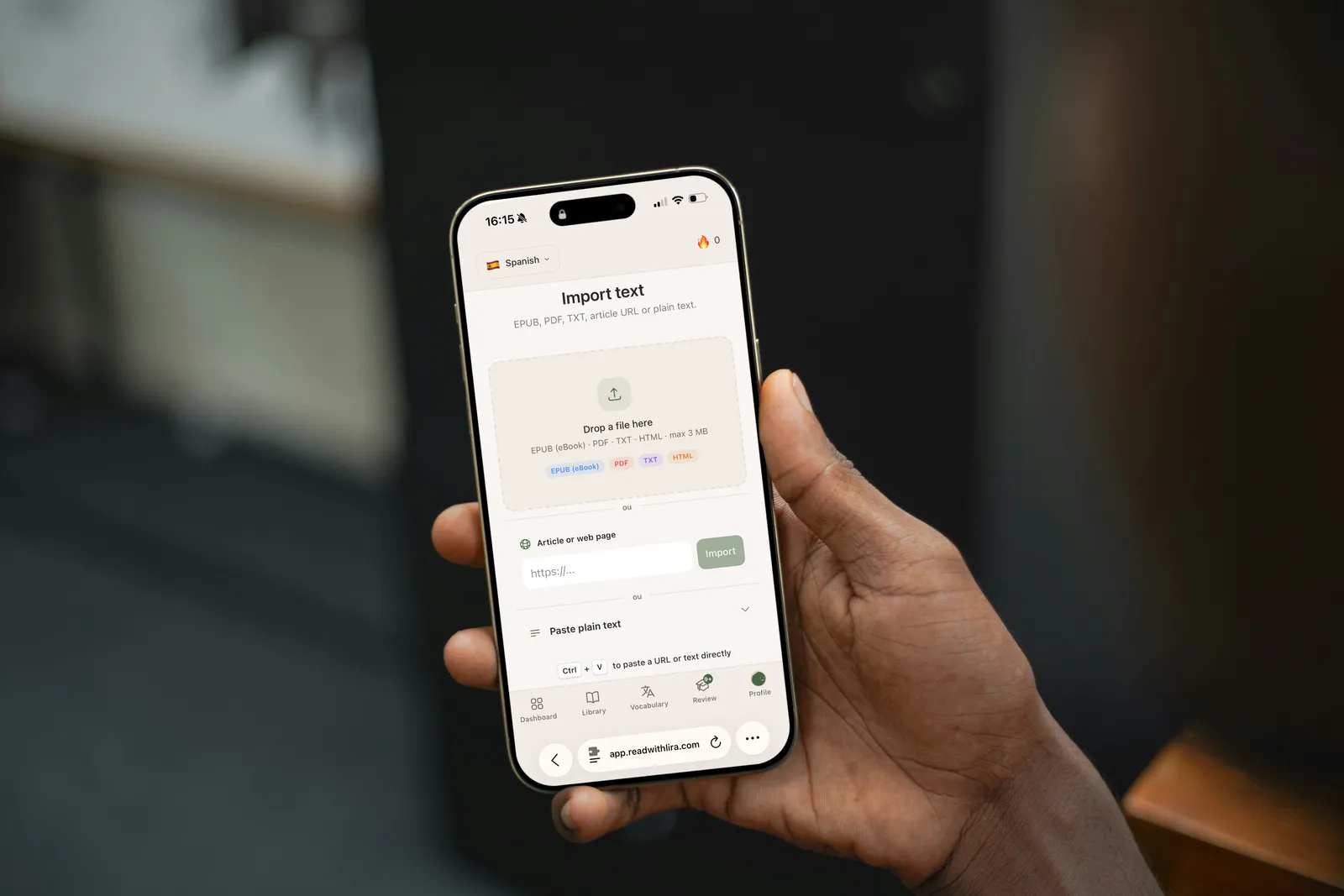
Lira starts from the opposite premise: instead of artificially simplifying the language, it lets learners read real content (novels, articles, essays) and helps them understand along the way. You import an EPUB, a PDF, an article URL, or pasted text, or pick from the library of public-domain classics if you don't have anything on hand.
Tapping an unknown word shows its contextual translation without leaving the page. No need to step out of the text to open a separate dictionary. That minimal friction is what lets you sustain a long reading session instead of giving up at the third tricky sentence.
Words you encounter then move into spaced repetition with FSRS (Free Spaced Repetition Scheduler), an algorithm that schedules reviews at the optimal moment for long-term retention. Reading becomes a real, measurable lever for progress, not just a pleasant activity with no tracking.
Another often underrated advantage: reading topics you genuinely care about increases motivation to keep going. A history buff reading an essay in German progresses faster than repeating dialogues about the weather, because they have a reason to finish the text.
This isn't a replacement for structured grammar instruction either. Reading teaches vocabulary in context and trains your ear for how the language actually flows, but it won't explain why a verb takes the subjunctive. That's still a gap worth filling with a grammar reference or, for a beginner, exactly the kind of structured course Busuu provides.
To get started, check our FAQ for details on which formats and languages are supported (French, English, German, Spanish, Italian).
Why authentic content changes the pace of progress
A scripted dialogue is written to illustrate a rule. A news article or a book chapter is written to tell you something. That difference in intent changes everything else: sentence length, vocabulary density, the order ideas unfold in.
A learner who only reads simplified content builds one particular skill, recognizing isolated vocabulary, without ever training the one they'll actually need: sticking with a three-page text despite ten unknown words. That tolerance for ambiguity builds gradually, text after text, not all at once.
That's why picking the first text matters as much as the tool itself. A text that's too hard discourages you within a few pages. A text that's too easy teaches nothing new. Aiming for a text where roughly 90% of the vocabulary is already familiar remains a solid rule of thumb, widely shared among language teachers.
Busuu vs Lira: comparison table
| Criteria | Busuu | Lira |
|---|---|---|
| Target level | Complete beginner (A0-A1), progressing to B2 | Intermediate and advanced (A2/B1 and up) |
| Content format | Short lessons and scripted dialogues | Real long-form texts (books, articles, essays) |
| Correction | Native speaker community + AI chatbot | No correction of written or spoken output |
| Translation | Built into exercises | Contextual translation on tap, while reading |
| Vocabulary review | Repetition built into lessons | FSRS spaced repetition on vocabulary encountered while reading |
| Price | Freemium, premium subscription around $13.99 per month depending on plan length (Busuu, pricing) | Freemium with a premium subscription |
| Languages | 12+ languages | French, English, German, Spanish, Italian |
The two tools don't cover the same need. Busuu builds the foundations and corrects your output. Lira trains reading comprehension on real content, once those foundations are in place.
FAQ
Can you use Busuu and Lira at the same time?
Yes, and it's actually a coherent combination. Many learners keep Busuu for maintaining base vocabulary and getting corrected speaking practice, then add a reading session with Lira to get exposure to authentic text. The two methods complement each other rather than compete.
Is Busuu really free?
Busuu offers a free tier with limited access to lessons and community correction features. Most of the content (full courses, AI chatbot, offline mode) is reserved for the premium subscription, priced above the market average for language-learning apps.
At what level should I switch to reading real texts?
A2/B1 is a good benchmark. Below that, you still lack the base vocabulary to tolerate unknown words in an authentic text without getting discouraged. Beyond that point, assisted reading becomes one of the most effective ways to progress toward an advanced level.
What if I don't have a book or article on hand to get started?
Lira includes a library of public-domain classics accessible directly in the app, so you don't need to hunt for a text elsewhere. It's a good starting point to test assisted reading before importing your own content, recent novels, news articles, or essays in PDF or EPUB format.
Does Lira correct grammar or pronunciation like Busuu does?
No. Lira focuses on reading comprehension and vocabulary retention, not on correcting written or spoken output. If you need feedback on your own production, a course with community or AI correction, like Busuu, still fills that gap. That's exactly why the two tools work well together at different points in the same learning path.
For a broader look at language apps, check our full comparison or get in touch with any questions about the levels and languages Lira supports.
Claire
Editor at Lira, self-taught in 3 languages, she tests every method or tool before writing about it.
Start reading in your target language
Import a book, an article, or pick a free classic, and Lira translates unknown words as you go.
Start for freeRelated articles

Ebook or Physical Book: Does the Format Matter for Language Learning?
Ebook or paper for learning a language by reading? The format matters less than lookup speed, and that's where digital reading actually wins.

How FSRS spaced repetition works in Lira
FSRS calculates the optimal review interval for every word you learn. Here's exactly how that works in Lira, word by word.
How to Import a Book or Article Into Lira
A step-by-step guide to importing an EPUB, PDF, URL, or plain text into Lira, and how to start reading the right way.